
Hartford County City Directory Holdings
Hartford County is best approached through named municipal and library collections, not a single county shelf. The New York Public Library catalog describes Geer's Hartford, West Hartford, East Hartford directory as volumes 1 through 92, running from 1838 through 1929. Its notes break out Gardner's Hartford City Directory, volumes 1-4 for 1838-1841, Geer's late Gardner's volume 5 for 1842, Geer's Hartford city directory volumes 6-83 for 1843-1920/21, and volumes 84-92 for 1921/22-1929 after West and East Hartford enter the title. Imprints move from M. Gardner to E. Geer and then Hartford Printing Company. Search by title variant as well as year.
| Collection | Years | Where Held | Access |
|---|---|---|---|
| Gardner's Hartford City Directory, volumes 1-4 | 1838-1841 | NYPL catalog; HPL History Center inquiry | Request the exact year; holdings vary |
| Geer's late Gardner's volume 5; Geer's volumes 6-83 | 1842; 1843-1920/21 | NYPL catalog and HPL | Confirm scan, microfilm, or offsite status |
| Geer's Hartford, West Hartford, East Hartford, volumes 84-92 | 1921/22-1929 | NYPL catalog and HPL | Advance request for year and volume |
| Hartford city directory volume | 1860-1861 | FamilySearch Library Books | Digitized scan; cataloged microfilm/microfiche |
| Hartford Town and City Clerk Archives | 1635-2010, mostly 1839-1947 | HPL ArchivesSpace and History Center | Finding aid, reading room, staff retrieval |
| Connecticut Historical Society local-history materials | Varies by item | Connecticut Historical Society | Search the collection; confirm visit access |
Catalog coverage is not the same as shelf availability. Some volumes may be offsite, restricted, or held on a format that needs a reader. Give the library the year, title variant, person or street, and call number before traveling. A missing online scan should lead to a reference email, phone inquiry, microfilm request, reading-room appointment, or interlibrary loan rather than a conclusion that the volume never existed.
Before traveling, consult the Geer's Hartford catalog record for the title, volume number, imprint, and holding note.
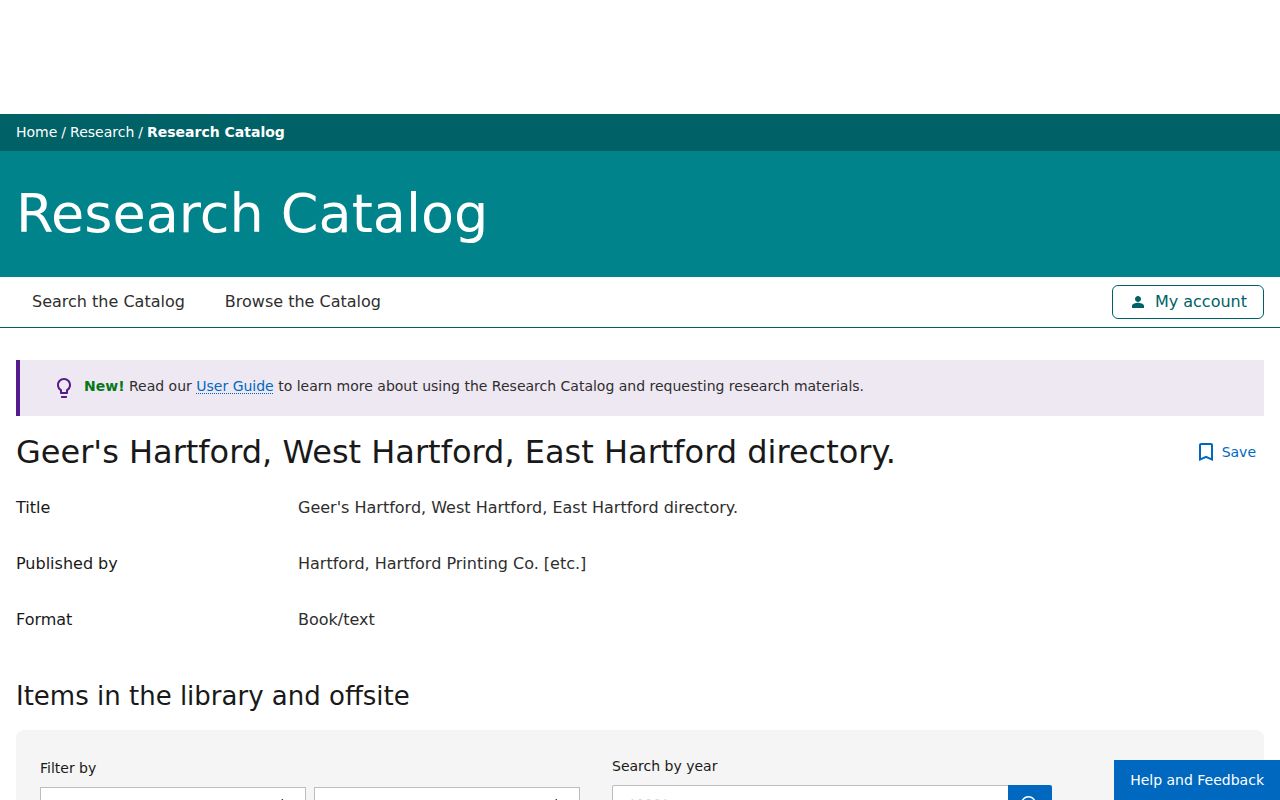
The catalog view helps separate a true year gap from a title change or a copy held at another research library.
Hartford County's Gardner and Geer Directories
The sequence is a timeline, not one unbroken list of everyone who lived in Hartford. The research record describes 1828 as the first published directory, then the 1838 Gardner volumes begin the long run cataloged by the New York Public Library. By 1843, Geer's name governs the main Hartford sequence. The 1921/22 expansion to West and East Hartford matters when a family crosses a town line but remains in the same urban area.
| 1799 | Reprint with landmark and street-segment placement, not stable modern numbers |
|---|---|
| 1828 | First published directory described in the archive record, roughly 2,000 names |
| 1838-1841 | Gardner's volumes 1-4; the archive description gives roughly 1,625 names for 1838 |
| 1842 | Geer's late Gardner's volume 5 |
| 1843-1920/21 | Geer's Hartford city directory volumes 6-83 |
| 1921/22-1929 | Volumes 84-92 add West and East Hartford to the title |
Publication dates are not occupancy dates. A person may be omitted, a business may be listed separately, or a move may fall between volumes. Keep the volume, year, page, and edition together, and never treat a missing name as proof of death or departure.
Hartford County's 1799 City Directory Clues
The 1799 Directory for the City of Hartford reprint teaches why early city directories need patient map work. Entries use a person, an occupation, and a place description. One sample reads “Ackley John, butcher, Water street.” Another places Caldwell James on Main street, north of the bridge. A longer Cogswell entry gives the side of Main Street, a position south of the State House, and an office in a house north of a named neighbor. These are useful historical clues, but they are not modern numbered addresses.
The archive description places the 1799 city population at about 5,000 and describes the first published directory in 1828 as roughly 2,000 names. That scale helps explain the sparse style. Compare the street segment with a later volume, a historical map, or the Hartford Sanborn sheet before assigning an old entry to a present parcel. Occupation also needs care: a shop, office, and home could be recorded in different ways.
Hartford County City Directory Archives
The Hartford History Center at Hartford Public Library is the strongest local starting point for historical people and address work. Its stated holdings include city directories, city archives, manuscripts, scrapbooks, pamphlets, photographs, maps and atlases, yearbooks, parks records, calendars, graphics, and memorabilia. The center is at 500 Main Street, Hartford, CT 06103; reference staff can be reached at 860-695-6300 or reference@hplct.org. Check current hours and item availability before a visit.
The Hartford Public Library history page provides the local collection context and contact path.

The History Center's wider holdings matter when a directory name needs a newspaper clipping, yearbook, photograph, map, or city-archive reference.
For finding aids, the HPL ArchivesSpace search accepts search terms, AND, OR, phrase operators, resource, accession, or archival-object record type, search field, from and to years, and additional search rows.
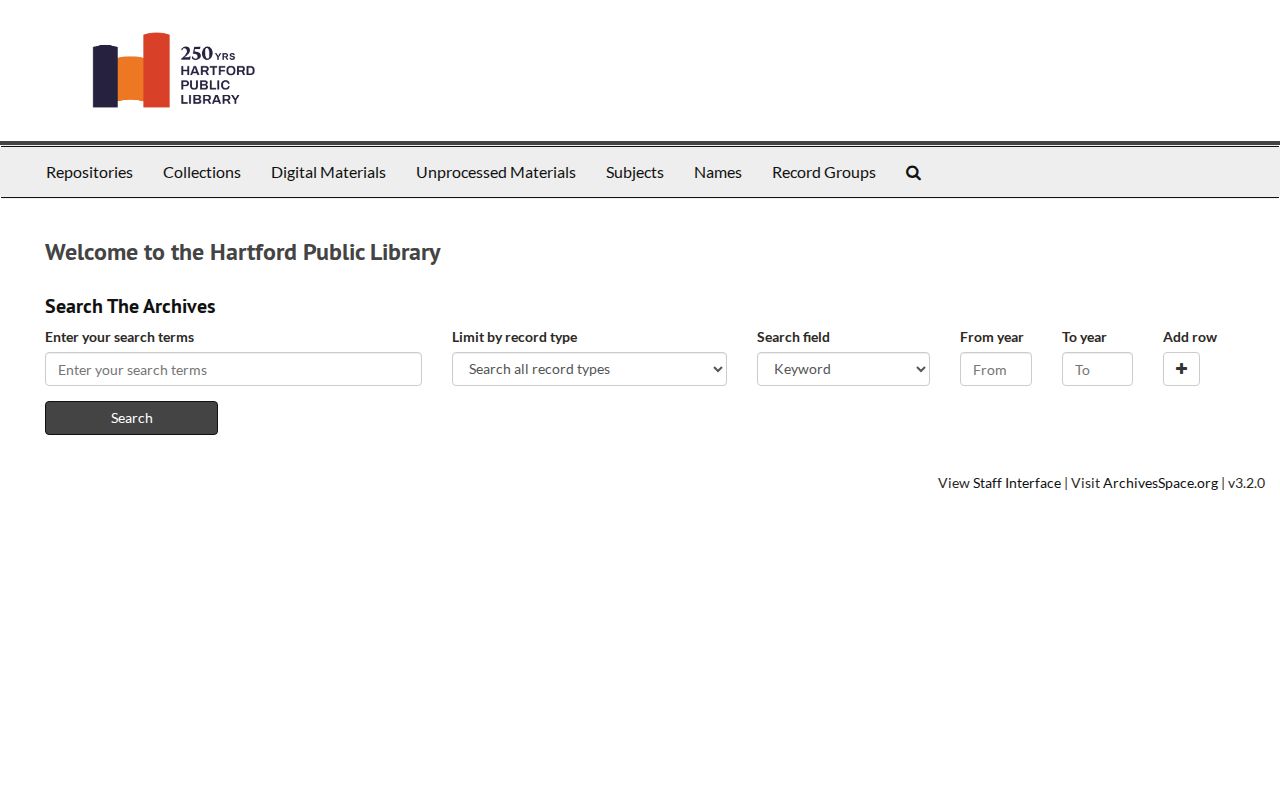
Use those filters to narrow a directory title, municipal collection, or archival object. Reading-room restrictions, advance requests, closed boxes, and offsite retrieval can apply.
The Town and City Clerk archival finding aid reports records from 1635-2010, with most material from 1839-1947.
That municipal archive is a different layer from a live index. Ask staff for the exact archival object, year, and access condition.
The 1860-1861 Hartford County Directory Scan
The FamilySearch 1860-1861 volume is a useful bridge between early address history and the later Gardner and Geer sequence. Its catalog record identifies a Hartford city directory including West Hartford and East Hartford, and it points researchers toward a digitized book while also recording microfilm, microfiche, and online directory filters.
Open the FamilySearch 1860-1861 Hartford directory record before searching page images.
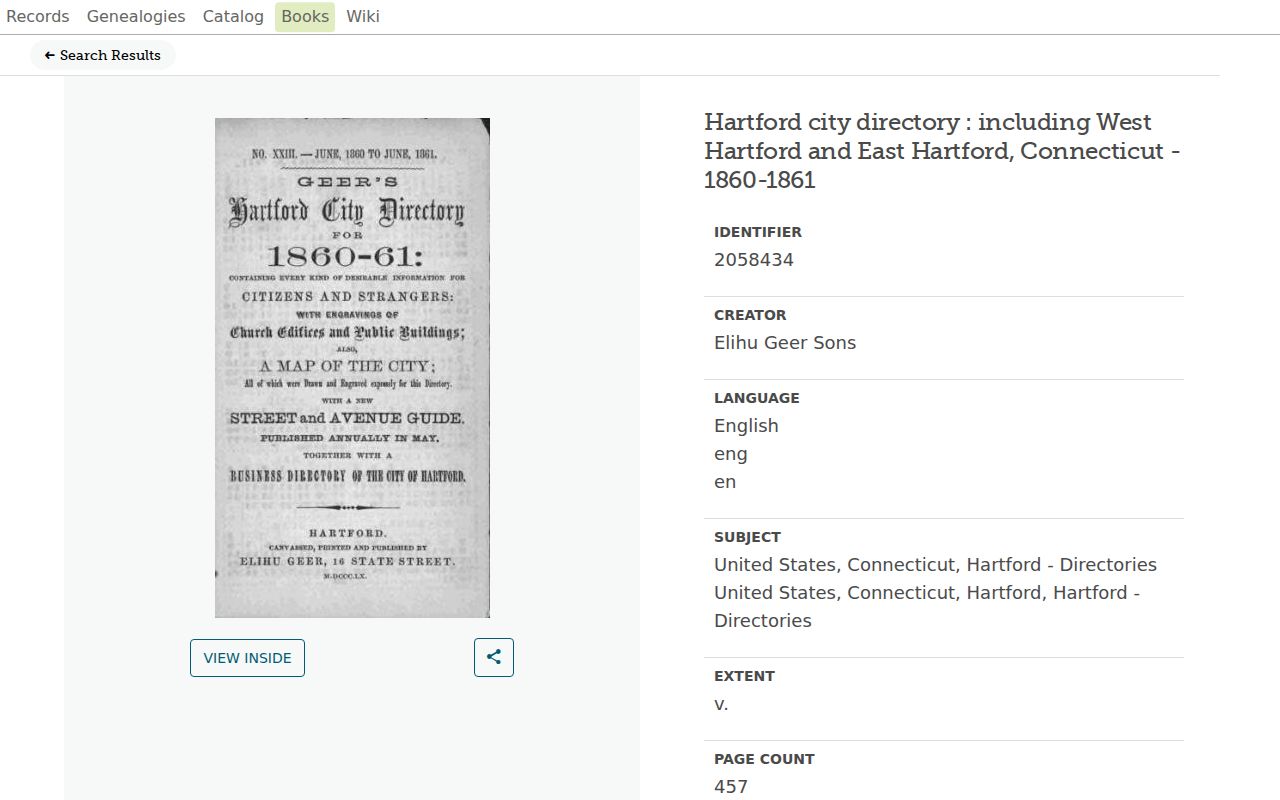
The scan can expose a page or spelling that a catalog line alone cannot, but OCR and page numbering still need checking against the image.
Use a practical fallback chain when the digital view stops short: search the online catalog or finding aid, ask for a scan or microfilm, send a reference email or phone request, visit the reading room with the title and year, then try interlibrary loan or an established genealogy-library copy. Town clerks remain important for historic land and vital originals. The Connecticut State Library and State Archives can identify newspapers, clippings, obituaries, and state-level material that HPL does not hold.
Reading a Hartford County City Directory Entry
A city directory entry is a compact bundle of clues. Read each mark in the context of its year and volume, then save the page image or citation before moving to the next source.
| Printed identity | Name, initials, title, and any spouse or household relation the edition supplies |
|---|---|
| Occupation | Historical work label, such as butcher or physician, with care around business listings |
| Address or placement | House number and street when present; early entries may give street side, ward, or landmark |
| Owner or renter mark | Use only when that volume defines the symbol or notation |
| Source note | Year, volume, page, scan or microfilm call number, and any OCR problem |
- Criss-cross directory
- An address-first directory arranged by street and house number, useful when the name is unknown.
- Householder index
- A name or household-head section that points to a printed address entry.
- Abbreviation key
- The volume's own guide to short forms and symbols; photograph it before interpreting marks.
Do not turn an occupation into a present identity claim. A business address may not be a residence, an owner mark may not describe every occupant, and an absent spouse notation proves very little.
Beyond Surnames in Hartford County Directories
The Library of Congress reverse-directory guide explains the address-first method: search a street and house number, then read the name attached to that location. For Hartford, a confirmed local volume still has to be found in a library catalog or reading room. Requests should state the directory type, place, and year, because advance notice or daily request limits may apply.
When a surname search fails, translate the address through a street segment, a neighboring household, or a later number. That method respects Hartford's changing street geography without pretending that every old number maps cleanly to a current parcel.
The Connecticut Historical Society collection and visit information provide an additional established repository for Connecticut people, places, images, and material culture.
Use its current catalog and access instructions to determine whether a Hartford item is available, processed, or appointment-only.
Maps and Memory Around Hartford County Directories
The Library of Congress Hartford Sanborn map gives a concrete comparison point: Hartford, Volume 3, 1922-August 1950, sheet 70, with West Hartford context in the metadata. A Sanborn sheet can show buildings, construction, street names, block or house numbers, utilities, and fire-protection details. Use it to interpret a historic footprint or numbering change, not to identify current residents.
Names that disappear from a volume often need a second endpoint. The Connecticut State Library collections offer newspapers, clipping files, obituaries, catalogs, and finding aids. No standalone official Hartford obituary index was located in the research, and no complete official online interment-name index was located for the Hartford Parks and Cemetery Division. Ask HPL or State Library staff for a date and name search, then contact the cemetery division for burial listings or archive help.
Record the gap plainly. An obituary may give a relative, church, funeral home, or former address, while a cemetery record may add a plot or burial clue. Neither replaces a certified vital record.
Note: An obituary can supply a relative or former address, but it is not a certified death record.
Trace Hartford County Families Through City Directories
Start with the strongest name, street, or occupation clue, then build a source trail that another researcher could repeat.
- Find the first likely volume and record the printed name, page, year, and title variant.
- Check nearby years for address changes, spouse or household notes, occupations, and changes in the abbreviation key.
- Switch to a criss-cross section when the surname index stops, and compare neighbors or a known street segment.
- Pair directory years with census years, HPL archival material, newspapers, obituaries, or cemetery records, marking each gap.
- Cite the scan or catalog record and separate historical placement from any claim about a living person.
A person who vanishes may have moved, died, changed a name, gone unlisted, or fallen outside that edition's scope. Check the next volume, a nearby town title, and the archive's finding aid before choosing an explanation. When the question shifts to a current address chain, use the Hartford County by-street records page; when a historical hit needs a present-day record check, use the Hartford County resident lookup. Keep those modern results separate from the historical directory citation.